
What Is Obsessive-Compulsive Disorder (OCD)?
When Doubt Becomes a Prison of Anxiety
Many people living with obsessive-compulsive disorder spend years believing they are simply "overthinking," "too anxious," "too responsible," or "too sensitive."
Others wonder:
"Why can't I stop thinking about this?"
"What if my thoughts mean something about me?"
"Why do I need so much reassurance?"
"Why do I feel responsible for things that haven't even happened?"
"Why can't I let this go?"
If this sounds familiar, you are not alone.
Obsessive-Compulsive Disorder (OCD) is a common and highly treatable anxiety-related condition that affects people of all ages, backgrounds, cultures, and professions. OCD is not a personality flaw, a preference for organization, or simply being particular about cleanliness or order.
It is a disorder of doubt, uncertainty, and fear that can significantly interfere with daily life.
Research suggests that OCD affects more than 1 in 100 people worldwide. It can impact relationships, work, school, parenting, decision-making, and overall quality of life.
At Aria Integrative Therapy, I specialize in helping adults understand and overcome OCD using evidence-based treatment approaches that address the underlying processes keeping symptoms alive.
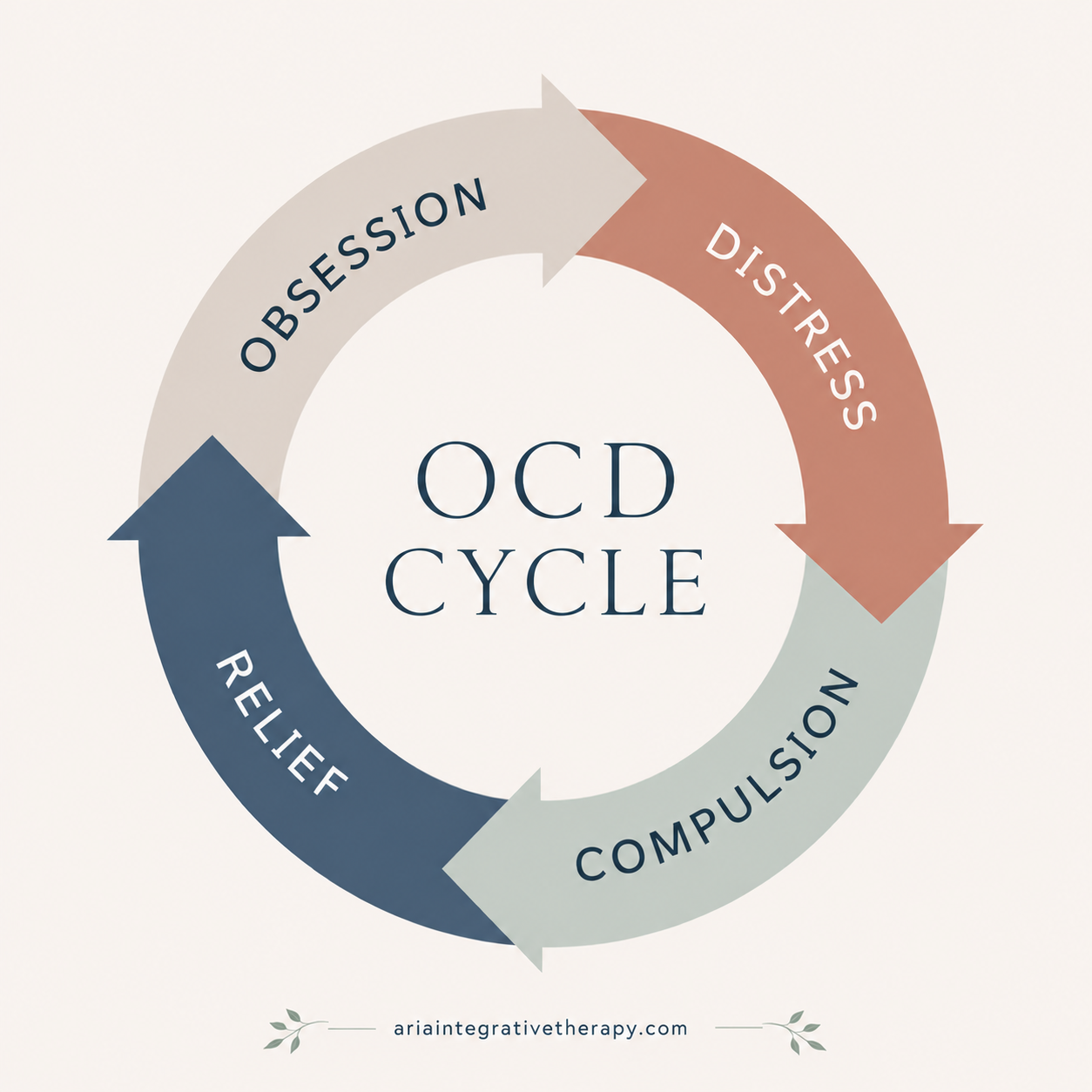
The OCD Cycle
OCD often operates as a self-reinforcing cycle involving two components:
Obsessions
Intrusive thoughts, images, urges, sensations, or doubts that create distress.
Compulsions
Behaviors or mental rituals performed to reduce anxiety, gain certainty, or prevent something feared from happening.
The relief provided by compulsions is usually temporary. Unfortunately, the more we respond to OCD, the more convincing it becomes.
Over time, this cycle can become exhausting and begin to consume enormous amounts of emotional energy, time, and attention.
For OCD to be diagnosed, symptoms typically:
Occupy a significant amount of time, often more than one hour each day.
Cause substantial distress.
Interfere with work, relationships, family life, school, or other valued activities.
What Are Obsessions?
Obsessions are unwanted and intrusive experiences that repeatedly enter awareness despite attempts to ignore, suppress, or resolve them.
These may include:
Thoughts
Images
Urges
Doubts
Sensations
Mental scenarios
People with OCD generally do not want these experiences. In fact, obsessions often target the things that matter most to a person, including their relationships, values, morality, health, safety, or identity.
Although many individuals recognize that their fears may not be logical, the thoughts often feel urgent, important, and dangerous.
Obsessions frequently trigger:
Anxiety
Fear
Uncertainty
Disgust
Guilt
Shame
Doubt
A sense that something is incomplete or "not right"
Because these experiences feel so convincing, people often become trapped trying to find certainty or relief.
Common OCD Themes
OCD can attach itself to virtually any topic. Some common themes include:
Contamination fears
Health anxiety and illness concerns
Harm OCD
Relationship OCD
Religious or moral OCD
Sexual intrusive thoughts
Responsibility for preventing harm
Fear of making mistakes
Existential questions
Identity-related doubts
Perfectionism and "just right" experiences
Symmetry and ordering concerns
The specific content of OCD varies from person to person, but the underlying process of doubt and compulsive responding remains remarkably similar.
What Are Compulsions?
Compulsions are the actions people take in an attempt to reduce anxiety or gain certainty.
Some compulsions are visible, while others happen entirely inside the mind.
Common behavioral compulsions include:
Excessive handwashing
Checking locks, appliances, or mistakes
Repeating actions
Arranging or organizing
Avoiding triggers
Asking others for reassurance
Mental compulsions may include:
Rumination
Reviewing memories
Mentally checking feelings
Analyzing thoughts
Repeating phrases
Internal reassurance
Trying to prove that feared outcomes are impossible
Many people with OCD feel frustrated because the relief from compulsions is short-lived. The anxiety eventually returns, often stronger than before.
"But Doesn't Everyone Have Intrusive Thoughts?"
One of the most common misconceptions about OCD is that everyone is "a little OCD."
While most people experience occasional unwanted thoughts, OCD is different.
Research suggests that intrusive thoughts occur in the general population. The difference lies in how those thoughts are experienced and responded to.
In OCD:
Thoughts occur more frequently.
The thoughts feel threatening or meaningful.
Anxiety becomes intense.
The person feels compelled to respond.
Daily functioning becomes disrupted.
Someone without OCD may notice an intrusive thought and move on.
Someone with OCD may spend hours analyzing it, seeking certainty, or trying to prevent something bad from happening.
Insight and OCD
Many individuals with OCD recognize that their fears are unlikely or exaggerated.
However, OCD is not a problem of intelligence or logic.
People often tell me:
"I know this doesn't make sense."
"Part of me knows it's OCD."
"I know the chances are small."
"But it still feels real."
This conflict between what you know intellectually and what you feel emotionally can be one of the most painful aspects of OCD.
Some people have strong insight into their symptoms, while others experience greater conviction in their fears. Both experiences are common.
OCD Is Not a Personality Trait
Being organized does not mean someone has OCD.
Liking things neat does not mean someone has OCD.
Being conscientious, responsible, or detail-oriented does not mean someone has OCD.
The difference is distress.
OCD involves unwanted obsessions and compulsions that interfere with daily life and create significant suffering.
Most people with OCD wish they could stop the thoughts, doubts, rituals, and mental checking that consume their energy.
Effective Treatment Is Available
OCD is highly treatable.
Research consistently supports specialized treatments such as:
Exposure and Response Prevention (ERP)
Inference-Based Cognitive Behavioral Therapy (I-CBT)
Acceptance and Commitment Therapy (ACT)
Certain medications when appropriate
At Aria Integrative Therapy, I specialize in helping adults understand how OCD operates, why it feels so convincing, and how to break free from its cycle.
Treatment is collaborative, individualized, and tailored to your particular symptoms and goals.
You do not have to spend the rest of your life arguing with intrusive thoughts, seeking certainty, or organizing your life around fear.
Recovery is possible.
OCD Therapy at Aria Integrative Therapy
I provide evidence-based OCD treatment for adults in Scottsdale and throughout Arizona and Minnesota via telehealth.
Whether you struggle with:
Intrusive thoughts
Reassurance seeking
Rumination
Contamination fears
Relationship OCD
Health anxiety
Harm OCD
Moral or religious obsessions
"Pure O"
Perfectionism or "just right" experiences
You deserve treatment from a clinician who understands how OCD works and knows how to treat it effectively.
If OCD has been shrinking your world, treatment can help you begin expanding it again.
You do not have to figure this out alone.